
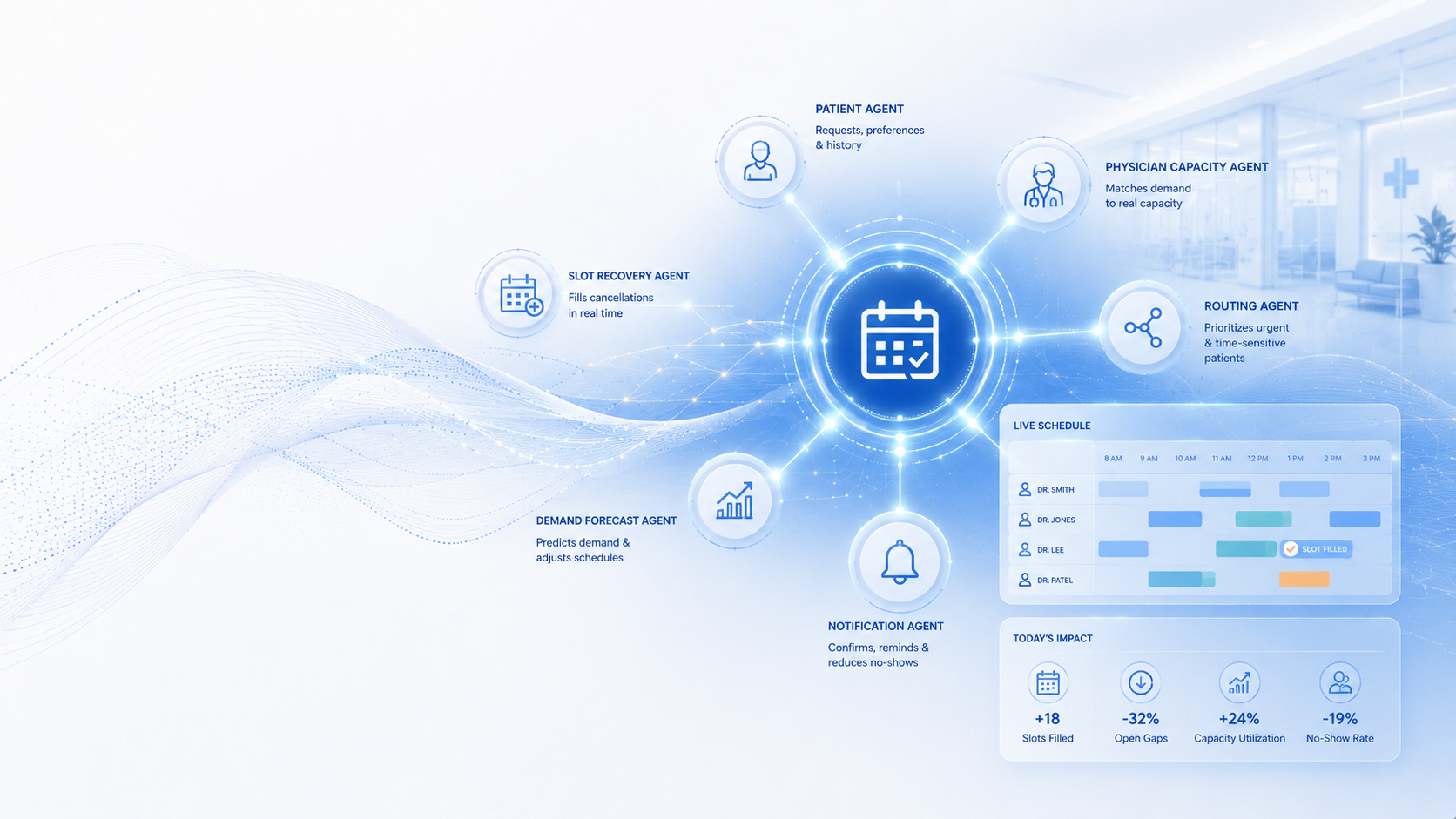
TL;DR: Clinic patient scheduling AI uses coordinated agents to fill cancelled slots, route urgent patients, and match physician capacity to real demand in real time. This matters now because specialty groups are racing to build digital-first front doors, and clinics still running static calendars are losing patient volume and margin to competitors that already automated scheduling.
Introduction
Clinic patient scheduling AI is becoming the front line of ambulatory revenue protection in 2026. Free-standing clinics still run static, rigid calendars that cannot react when a patient cancels or a physician’s morning opens up unexpectedly. That rigidity is not a minor inconvenience.
Every unfilled slot is lost margin, and every overcrowded morning followed by an empty afternoon is a sign that the schedule was never actually planned. It was a guess. Specialty physician groups now treat scheduling as a competitive front door, not a back-office function.
In our review of 2026 deployments, clinics that replaced static booking with autonomous scheduling agents recovered volume within weeks, not quarters. This whitepaper sets out how multi-agent scheduling architecture works, where it still fails, and how a COO or VP of Patient Experience should sequence a rollout.
Why Ambulatory Leakage Is a 2026 Priority
Three forces are converging on ambulatory clinics this year. No-show rates remain stubbornly high, digital-first competitors are capturing referral volume, and the gap between top and bottom performing clinics keeps widening.
| Metric | Figure | Source (Year) |
| US outpatient no-show rate range | 15% to 30% of scheduled visits | Neuwark clinical deployment data (2026) |
| Annual cost of no-shows to the US healthcare system | Approximately $150 billion | Neuwark (2026) |
| Referral-to-appointment conversion, top vs. bottom health systems | 76% vs. 41%, a 35-point gap | Innovaccer, The Economics of Patient Access (2026) |
| Annual revenue lost per low-performing system from referral leakage | $2.8 million | Innovaccer (2026) |
| Medical practices using AI for patient communication | Only 19%, leaving most of the field unautomated | MGMA (2025) |
Two of these figures carry direct operating weight. The Innovaccer survey of 110 hospital CFOs, COOs, and chief growth officers shows leakage concentrates in the handoffs between scheduling steps, not inside any single step. That is precisely the coordination problem multi-agent orchestration is built to solve.
What Is Clinic Patient Scheduling AI?
Clinic patient scheduling AI is a network of software agents that coordinate patient history, clinical urgency, and physician availability to fill cancelled slots and route waitlisted patients without manual intervention.
Traditional scheduling software treats a calendar as a fixed grid of slots. A human books a slot, and the slot stays booked or empty until someone manually changes it.
Clinic patient scheduling AI replaces that static grid with agents that watch for change. When a patient cancels, an agent immediately checks the waitlist for a clinically appropriate replacement instead of leaving the slot empty until staff notice.
The distinction that matters for a COO is reactive versus predictive. A reactive system waits for a human to notice a gap. A predictive system forecasts where gaps will likely open and pre-stages replacement candidates before the cancellation even happens.
How Does Agentic Patient Scheduling Work?
A Predictive Shift Allocation Engine forecasts capacity gaps, a scheduling agent matches waitlisted patients by urgency, and a calendar optimization module rebalances physician availability in real time.
The architecture runs on four coordinated agent roles, sequenced by an orchestrator that holds the live state of every provider’s calendar across the clinic.
- A monitoring agent watches for cancellations, no-shows, and reschedule requests as they happen, rather than at a nightly batch sync.
- A triage agent ranks the waitlist by clinical urgency and time sensitivity, not simply by first-come order.
- A matching agent tests waitlisted patients against the open slot for clinical fit, insurance, and physician specialty.
- The Predictive Shift Allocation Engine forecasts likely future gaps from historical cancellation patterns and pre-stages backfill candidates.
- A calendar optimization module rebalances physician shifts across the day when patterns show sustained over- or under-booking.
Consider a patient who cancels a 9:00 a.m. follow-up two hours before the visit. A static system leaves that slot empty. A matching agent instead checks the urgent waitlist, finds a patient flagged for follow-up within the week, confirms insurance fit, and fills the slot within minutes.
We call this model Predictive Shift Allocation: instead of reacting to a gap after it opens, the system forecasts where gaps are statistically likely and pre-stages the fix. This framing does not appear in existing scheduling vendor content, which still describes automation mainly in terms of reminders and confirmations.
Key Use Cases for Agentic Scheduling
Real-Time Cancellation Backfill
Prosper AI reports that one clinic’s AI agent delivered a 35x return on investment purely from backfilling last-minute cancellations. The agent matched waitlisted patients to newly opened slots before staff would have noticed the gap.
Conversational Intake and Self-Scheduling
Epic’s patient-facing agent, Emmie, has handled appointment rescheduling inside MyChart at scale. At Ochsner Health, patients have rescheduled more than 14,900 appointments through Emmie, saving close to 750 hours of staff time.
Provider Utilization Rebalancing
Prosper AI’s research found that UCHealth used AI scheduling to decrease unused provider time, adding an estimated $8 million in value from higher throughput. The same logic applies directly to a multi-physician ambulatory group running uneven daily volume.
Waitlist Management Automation
Prosper AI also documents a clinic that cut time spent on waitlist management from 40 hours a month to under five. That recovered staff time can be redirected to patients who need a human conversation, not a scheduling lookup.
Where Agentic Scheduling Still Creates Risk
No scheduling deployment should be marketed as risk-free, and COOs should expect friction in three areas: triage bias, governance gaps, and regulatory classification uncertainty.
- Triage algorithms can undertriage protected groups. A large multi-center study of more than five million ED encounters found black male patients faced a 41% higher chance of undertriage than white female patients.
- Bias compounds when proxy variables substitute for clinical judgment. Research on AI triage systems shows algorithms that used healthcare cost as an illness proxy systematically undertriaged Black patients because of unequal access-driven cost differences.
- Regulatory classification is unsettled. Some scheduling and triage tools may qualify as Software as a Medical Device, and many vendors avoid that classification by framing output as non-determinative decision support a clinician must still review.
- The EU AI Act will treat high-risk healthcare AI systems with explicit obligations covering risk management, data governance, transparency, and human oversight, a bar most current scheduling agents have not been tested against.
- Equity-stratified outcome data remains thin. A 2026 Journal of Medical Internet Research review found scant real-world evidence on triage safety across age, ethnicity, language, and deprivation groups.
Our analysis shows the practical mitigation is procedural: keep a clinician in the loop for any urgency ranking above a defined acuity threshold, and audit backfill decisions quarterly for demographic skew.
How Requirements Differ by Clinic Size and Specialty
A single-location primary care clinic needs a simpler agent configuration than a multi-site specialty group coordinating physicians across locations. Specialty mix also changes which agent role matters most.
| Dimension | Single-Site Primary Care | Multi-Site Specialty Group |
| Primary agent priority | Cancellation backfill and reminders | Calendar optimization across multiple physicians and locations |
| EHR integration need | Single EHR instance, e.g. a standalone Epic or NextGen build | Multiple EHR or practice management systems requiring unified orchestration |
| Typical urgency variance | Low; most visits are routine follow-up | High; specialty triage requires clinical urgency scoring per condition |
| Staffing impact | Front desk time reallocated to patient calls | Scheduling coordinators reallocated to complex case management |
Implementation Checklist for Clinic Leadership
Sequence the rollout by phase. Do not remove human review from urgent-case routing until the matching agent has a proven track record on routine cases.
Phase 1: Foundation (Weeks 1-4)
- Inventory every provider calendar, EHR instance, and scheduling channel currently in use.
- Pull twelve months of cancellation and no-show history to train the Predictive Shift Allocation Engine.
- Define clinical urgency tiers the triage agent will use to rank the waitlist.
- Assign a named clinical owner accountable for reviewing agent-driven urgency rankings.
Phase 2: Pilot (Weeks 5-10)
- Deploy the monitoring and matching agents on a single physician’s calendar first.
- Run agent-proposed backfills in parallel with the existing manual waitlist process for two weeks.
- Measure slot-filling duration against the manual baseline before expanding scope.
- Audit a sample of agent-ranked waitlist decisions for demographic skew before scaling further.
Phase 3: Scale (Weeks 11-20)
- Extend the orchestrator to additional physicians and locations in order of cancellation volume.
- Activate the calendar optimization module only after single-physician matching is stable.
- Require vendors to disclose triage validation data, including any equity-stratified performance results.
- Schedule a quarterly review of agent-driven urgency rankings against actual clinical outcomes.
Key Metrics to Track
| Metric | What It Measures | What Good Looks Like |
| Patient scheduling leakage rate | Share of available capacity that goes unfilled or underutilized | Trending toward the 35% no-show reduction reported in 2026 conversational AI deployments |
| Slot-filling duration | Average minutes between a cancellation and a confirmed replacement booking | Under 15 minutes for routine visits |
| Net clinic booking value | Dollar value of visits actually completed against scheduled capacity | Growth in line with the $8 million throughput gain UCHealth reported |
| Triage equity audit pass rate | Share of quarterly demographic audits showing no significant ranking skew | 100%, reviewed every quarter without exception |
Looking Ahead
The direction for 2026 is clear even where triage governance is still maturing. Specialty groups that build a digital-first front door now are positioned to capture market share from clinics still running static calendars.
COOs do not need to solve every governance question before starting. A phased rollout that keeps clinicians in the loop on urgency decisions lets a clinic capture backfill revenue now while equity auditing matures alongside it.
Frequently Asked Questions ( FAQs)
Is clinic patient scheduling AI the same as appointment reminders?
No. Reminder systems only confirm an existing booking. Clinic patient scheduling AI actively monitors for cancellations, ranks the waitlist by clinical urgency, and rebooks a replacement patient automatically, closing the revenue gap a reminder alone cannot touch.
How much can scheduling AI reduce no-show rates?
Clinics deploying conversational scheduling AI report no-show reductions between 25% and 38% in 2026 deployment data. Results vary by specialty, patient population, and how tightly the agent integrates with the clinic’s existing EHR and reminder workflow.
Does this require replacing our EHR?
No. Leading scheduling agents integrate with existing systems such as Epic, Cerner, and NextGen through certified connectors rather than replacing the EHR. Most clinics layer the scheduling agent on top of their current practice management system.
What happens when an agent cannot find a clinically appropriate match?
A properly governed system escalates the open slot to a human scheduler rather than booking a poor clinical fit. Urgency thresholds and escalation rules should be configured before go-live so escalation is the default for ambiguous cases.
Is AI triage safe for ranking patient urgency?
Safety depends heavily on the training data and ongoing audit practice. Documented mistriage rates and racial disparities in some triage algorithms mean clinics must keep a clinician reviewing urgency rankings, not full algorithmic autonomy.
How long does a scheduling agent rollout take?
A phased rollout from single-physician pilot to multi-site scale typically spans roughly five months. Clinics that skip the pilot phase and automate urgency routing immediately report higher error rates and slower staff trust-building.
Will this work for a multi-specialty group with several locations?
Yes, though it requires a calendar optimization module coordinating across locations, not just a single-site matching agent. Multi-site groups should expect a longer Phase 3 scale-up than single-location primary care clinics.