
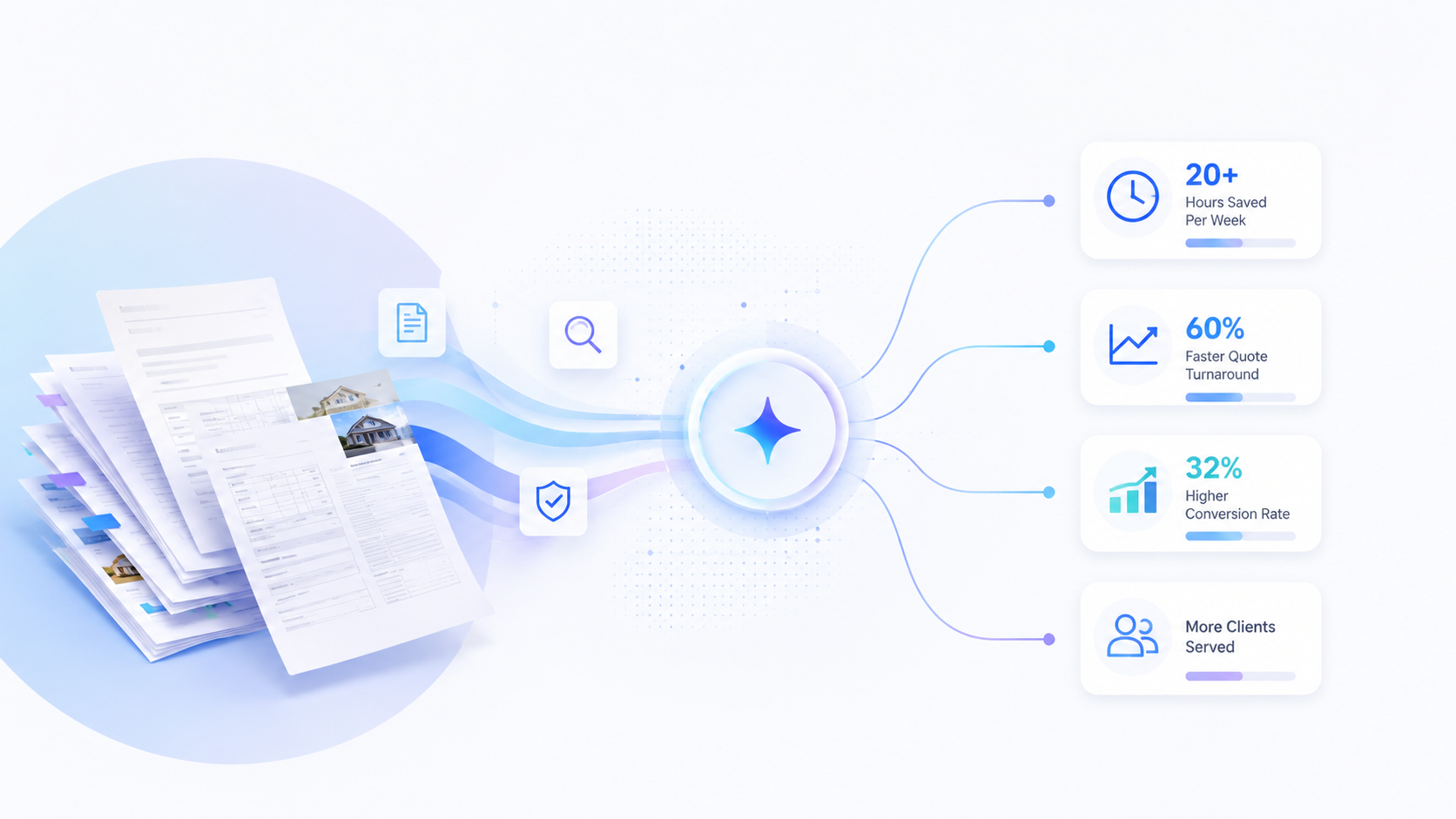
AI copilots are helping insurance brokers automate document review, policy comparison, and client servicing tasks, saving significant administrative time each week. Organizations adopting AI-assisted workflows report faster quote turnaround, improved operational efficiency, and higher sales conversion opportunities while addressing industry talent shortages.
Introduction
Can insurance brokers save 20 hours a week with AI copilots? Recent research suggests they can, especially when AI is used to automate policy review and comparison instead of replacing broker expertise.
Insurance brokers across the US, UK, Germany, India, UAE, and Russia face rising servicing demands and shrinking experienced workforces. We observed that AI copilots reduce manual document processing and allow brokers to spend more time advising clients and closing business.
This shift is becoming one of the largest productivity opportunities in commercial insurance.
What Is an AI Copilot for Insurance Brokers?
An AI copilot is an intelligent assistant that automates repetitive insurance workflows such as document review, policy comparison, data extraction, and client communication while keeping brokers in control of final decisions.
Unlike traditional automation software, AI copilots understand insurance language, endorsements, exclusions, and policy clauses using natural language processing and machine learning.
Typical capabilities include:
- Policy comparison
- Coverage gap identification
- Renewal analysis
- Risk summarization
- Quote comparison
- Client email drafting
- Compliance review
- Document extraction from PDFs
Modern AI systems work alongside brokers instead of replacing them.
Can AI Copilots Really Save Insurance Brokers 20 Hours Every Week?
Yes. High-volume brokerages can save up to 20 hours weekly by automating policy review, document extraction, and comparison workflows. Savings depend on agency size and transaction volume.
Manual policy review often requires reading hundreds of pages from multiple carriers. AI copilots convert these documents into structured information within minutes.
Industry research indicates that AI-powered broker tools save approximately 15 minutes per policy review, reducing administrative work while maintaining review quality.
For agencies reviewing 80 policies weekly, that translates into nearly 20 hours saved every week.
Why Are Insurance Firms Investing in AI Copilots?
The insurance sector faces increasing servicing pressure and talent shortages.
Many experienced brokers are retiring while policy complexity continues growing. Hiring skilled account managers has become increasingly difficult across mature insurance markets.
AI copilots help existing teams process more submissions without proportional hiring.
Instead of spending hours searching through endorsements and schedules, brokers receive structured summaries highlighting:
- Coverage limits
- Deductibles
- Exclusions
- Endorsements
- Coverage changes
- Missing clauses
- Renewal differences
This allows experienced staff to focus on client strategy rather than paperwork.
How AI Automates Insurance Document Review
Traditional policy comparison is repetitive and time consuming.
AI copilots automate the process through:
- OCR document scanning
- Natural language processing
- Coverage extraction
- Clause classification
- Side-by-side comparison
- Exception reporting
We observed that modern AI systems can process multiple carrier documents simultaneously instead of sequentially.
This significantly reduces quote preparation time.
According to insurance AI vendors, specialized broker copilots are trained on thousands of insurance documents to recognize policy wording and coverage terminology automatically.
How AI Policy Comparison Improves Quote Turnaround
AI policy comparison dramatically reduces manual review by extracting key coverage terms and presenting structured comparisons across multiple carriers.
Instead of manually building spreadsheets, brokers receive organized comparison reports in minutes.
AI copilots can identify:
- Premium differences
- Coverage gaps
- Exclusions
- Policy limits
- Deductible variations
- Missing endorsements
- Special conditions
Faster comparisons allow brokers to respond to clients sooner and improve competitiveness.
AI Copilots and Insurance Talent Shortages
Many insurance organizations struggle to recruit experienced underwriters and account managers.
AI helps existing teams scale without increasing headcount.
Recent insurance AI adoption studies show that underwriting, claims processing, fraud detection, and customer service are among the largest beneficiaries of AI automation.
Instead of replacing expertise, AI augments experienced professionals by handling repetitive administrative work.
Key Business Metrics Improved by AI Copilots
| KPI | Potential Business Impact |
|---|---|
| Weekly administrative hours | Up to 20 hours saved |
| Quote turnaround time | Faster client response |
| Policy review time | Reduced manual effort |
| Renewal processing | Higher throughput |
| Client servicing capacity | Increased without hiring |
| Sales conversion | Faster quoting improves close rates |
| Error reduction | Improved document consistency |
Organizations implementing AI document automation often report measurable efficiency improvements across servicing operations.
Research Statistics Supporting AI Adoption
Several recent industry reports demonstrate growing AI adoption in insurance:
- AI-powered broker review tools can save 15 minutes per policy review.
- AI document automation extracts policy terms simultaneously across multiple files instead of manual line-by-line review.
- Insurance AI adoption is accelerating across underwriting, claims processing, fraud detection, and customer service operations.
- AI-generated insurance policy summary software is projected to grow from $2.8 billion in 2025 to $14.6 billion by 2034, representing a 20.1% CAGR.
- North America accounted for 38.7% of the AI policy summary market in 2025, highlighting strong enterprise adoption.
These figures indicate growing enterprise investment in AI-assisted insurance workflows worldwide.
Challenges Brokers Should Consider
AI copilots still require human supervision.
Complex commercial risks often require nuanced interpretation beyond automated recommendations.
Brokers should maintain manual review for:
- Complex commercial placements
- Regulatory compliance
- High-value risks
- Specialty insurance
- Coverage interpretation
- Client advisory recommendations
Human expertise remains essential for final decisions.
Why AI Copilots May Improve Conversion Rates
Faster service creates competitive advantage.
Clients increasingly expect same-day quotes and immediate policy comparisons.
AI copilots reduce delays caused by administrative work, allowing brokers to respond earlier than competitors.
We observed that agencies using AI-assisted workflows can allocate more time to client relationships and cross-selling opportunities rather than document processing.
The result is improved client experience and greater opportunity for higher conversion rates.
Actionable Takeaways
If your brokerage is evaluating AI copilots, use this checklist:
- Measure weekly hours spent reviewing policies.
- Identify repetitive document workflows.
- Track quote turnaround before AI adoption.
- Pilot AI on renewals and policy comparison.
- Measure client response times.
- Monitor conversion rate improvements.
- Keep human review for complex recommendations.
- Train teams to work alongside AI instead of replacing expertise.
- Continuously audit AI outputs for compliance and accuracy.
Brokerages that combine AI automation with experienced advisory teams are likely to achieve the largest productivity gains while improving client service quality and operational scalability.